Quick answer
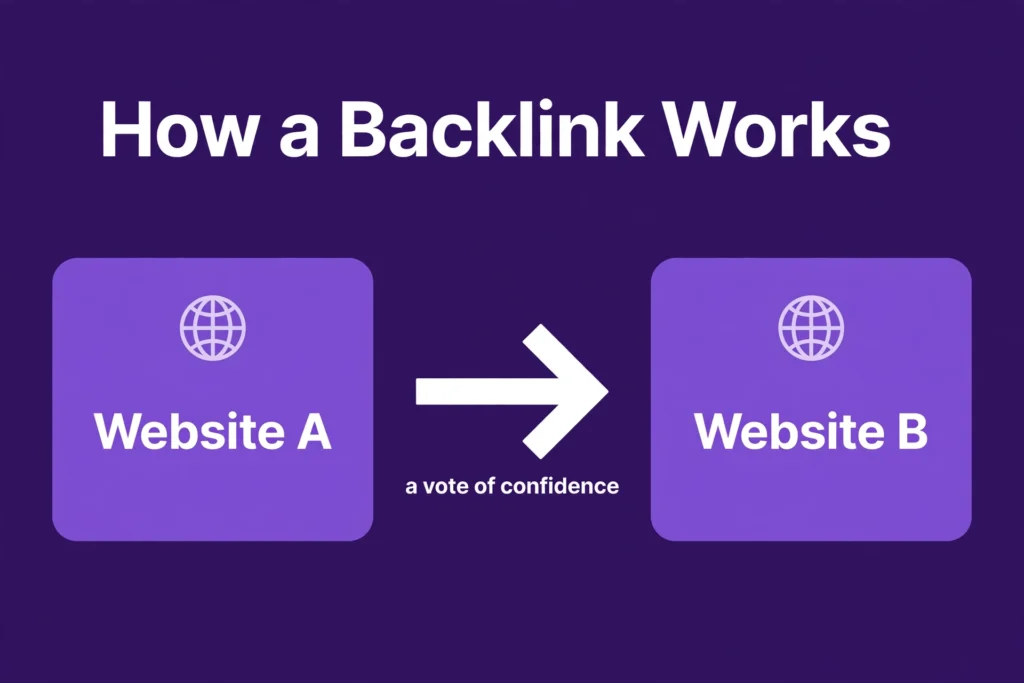
A backlink is a link on someone else’s website that points to your website. Search engines read it as a vote of confidence. If trusted, relevant sites link to you, Google takes it as a sign that your page is worth showing. Quality beats quantity every time. One link from a real, respected site is worth more than a hundred links from sites nobody reads.
What is a backlink?
Imagine you run a small fitness blog. You write a detailed guide about protein intake for beginners. A well known health magazine reads it, likes it, and links to it from one of their own articles. That link is a backlink. It points from their site to yours.
People also call backlinks inbound links or incoming links. All three names mean the same thing: a link coming in from another website.
It helps to keep three kinds of links apart:
- Backlink (inbound link): another site links to you.
- Internal link: one page on your own site links to another page on your own site.
- Outbound link: your site links out to someone else’s site.
Only the first one is a backlink. The other two matter for SEO too, but they are not the same thing, and mixing them up is one of the most common beginner mistakes.
Here is a simple example. Say a travel website publishes an article called “10 Best Beaches in Bali.” Inside that article, the words “Bali travel insurance guide” link to a page on an insurance company’s site. That insurance page just earned a backlink. The travel site gave it, the insurance site received it, and the clickable words are the anchor text.
What backlinks are not
Three things get confused with backlinks all the time, so let us clear them up.
First, social media likes and shares are not backlinks. A tweet linking to your page is a link in the technical sense, but social links are almost always nofollow, and they do not carry the same weight as an editorial link inside an article.
Second, a mention without a link is not a backlink. If a newspaper names your brand but does not link to you, that mention still helps your brand, and AI systems do notice brand mentions. But it is not a backlink, and it does not pass authority the way a link does. The good news is that unlinked mentions can often be turned into links with one polite email.
Third, a directory listing is not automatically a good backlink. Real directories used by real people are fine as a foundation. But a directory that exists only to sell listings, with no visitors and no editorial standards, adds nothing. If a site’s whole business is selling links, its links are worth very little, no matter what it charges.
How a backlink works
Every backlink has four parts. Once you see them, you will spot them everywhere.
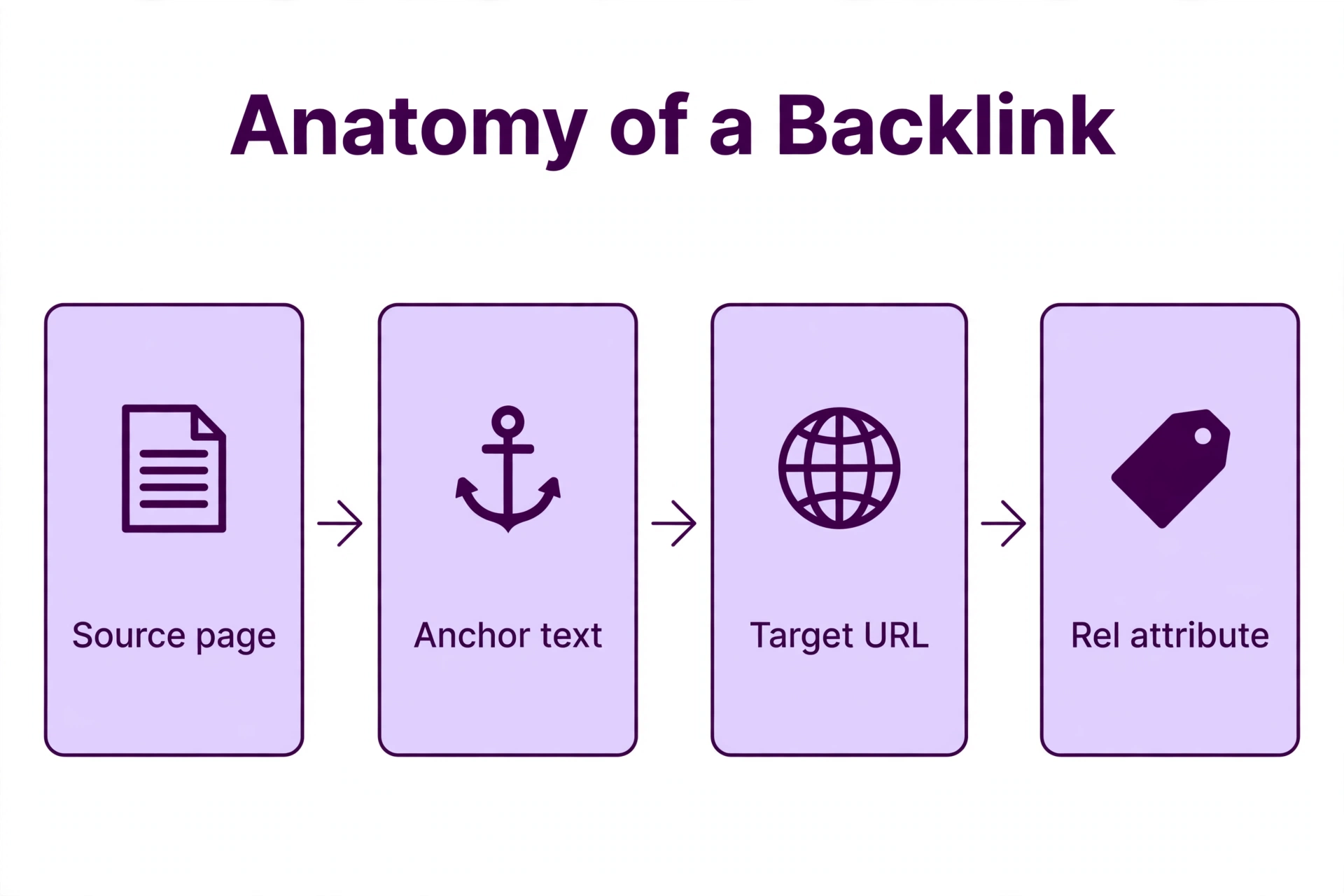
- The source page. This is the page where the link lives. Its topic, its authority, and its traffic all affect how much the link is worth.
- The anchor text. These are the clickable words. Good anchor text describes what the linked page is about. It should read naturally in the sentence.
- The target URL. This is the page being linked to. It receives the value.
- The rel attribute. This is a small piece of code that tells search engines how to treat the link. We will come to the four types in a moment.
When Google finds a new backlink, three things happen in order. First, Google’s crawler discovers the link while crawling the source page. Second, Google evaluates it: is the source real, is it relevant, is the link placed inside genuine content or hidden in a footer? Third, if the link passes those checks, some of the source page’s authority flows to your page. SEOs call this flow link equity. Older guides called it link juice. Same idea.
This is also why backlinks help Google discover your content. A new page with no links pointing to it can sit unnoticed for a while. A link from a page Google already crawls often gets your new page found and indexed much faster.
Why backlinks still matter in 2026
Search has changed a lot, and it is fair to ask whether backlinks still matter. Google itself has said links are less dominant than they once were. But less dominant does not mean dead. Backlinks still do four jobs that nothing else does quite as well.
Rankings. Links remain one of the strongest signals Google uses to judge whether a page deserves to rank. For competitive keywords, the pages at the top almost always have stronger link profiles than the pages below them. Content alone rarely wins a competitive term without links behind it.
Discovery and indexing. As above, links are how Google finds new pages. A page linked from active, crawled sites gets discovered faster than a page sitting alone.
Referral traffic. A link on a page real people actually read sends real visitors. This traffic does not depend on your ranking at all. A single link on a popular article can send visitors for years.
AI search citations. This is the new part. AI Overviews, ChatGPT, Perplexity, and Gemini answer questions by citing pages they trust. Pages with strong topical authority and genuine citations behind them are the ones that get picked. Backlinks are still one of the clearest trust signals these systems can read, alongside brand mentions. A page that nobody has ever linked to or mentioned has a much harder time being cited.
The honest version of the story is this: backlinks are not the whole of SEO anymore, and anyone who sells them as a magic button is lying. But a site with no backlinks is a site with no votes, no referrals, and no third party trust. That is a very hard place to rank from.
What makes a backlink good
Not all backlinks are equal. Ten years ago, SEOs counted links. Today, Google weighs them. Here are the six factors that decide whether a link helps you.
Relevance. A link from a site in your field is worth far more than a link from a random site. A fitness site linking to a protein guide makes sense. A casino site linking to the same guide does not, and Google notices the mismatch.
Authority. Links from established, trusted sites carry more weight. Authority is usually measured by tools as Domain Rating (DR) or Domain Authority (DA), but those are third party scores, not Google scores. Use them as a rough guide, not as gospel. Real traffic on the linking site is often a better single check than any score.
Placement. A link inside the main body of an article, surrounded by relevant text, is the strongest kind. Links buried in footers, sidebars, or author boxes count for much less, because they look like site furniture rather than editorial recommendations.
Anchor text. Natural anchor text describes the page honestly. If every link to your page uses the exact same keyword phrase, that looks engineered. A healthy profile has a mix: brand names, plain URLs, generic phrases like “this guide,” and the occasional keyword phrase.
Unique referring domains. Ten links from ten different websites beat ten links from one website. Google counts the number of distinct sites linking to you, not just the raw number of links. This is why one sitewide link repeated on every page of a site is nearly worthless.
Real traffic. Ask one simple question: does anyone actually visit the linking page? A link on a page with real readers can send referral traffic and looks like a genuine recommendation. A link on a page nobody visits is a line in a database.
If a link fails most of these tests, it is probably not helping you, even if a seller counts it in a report.
Types of backlinks
Backlinks come in two groups: by attribute (what the code tells Google) and by how they were earned.
By attribute
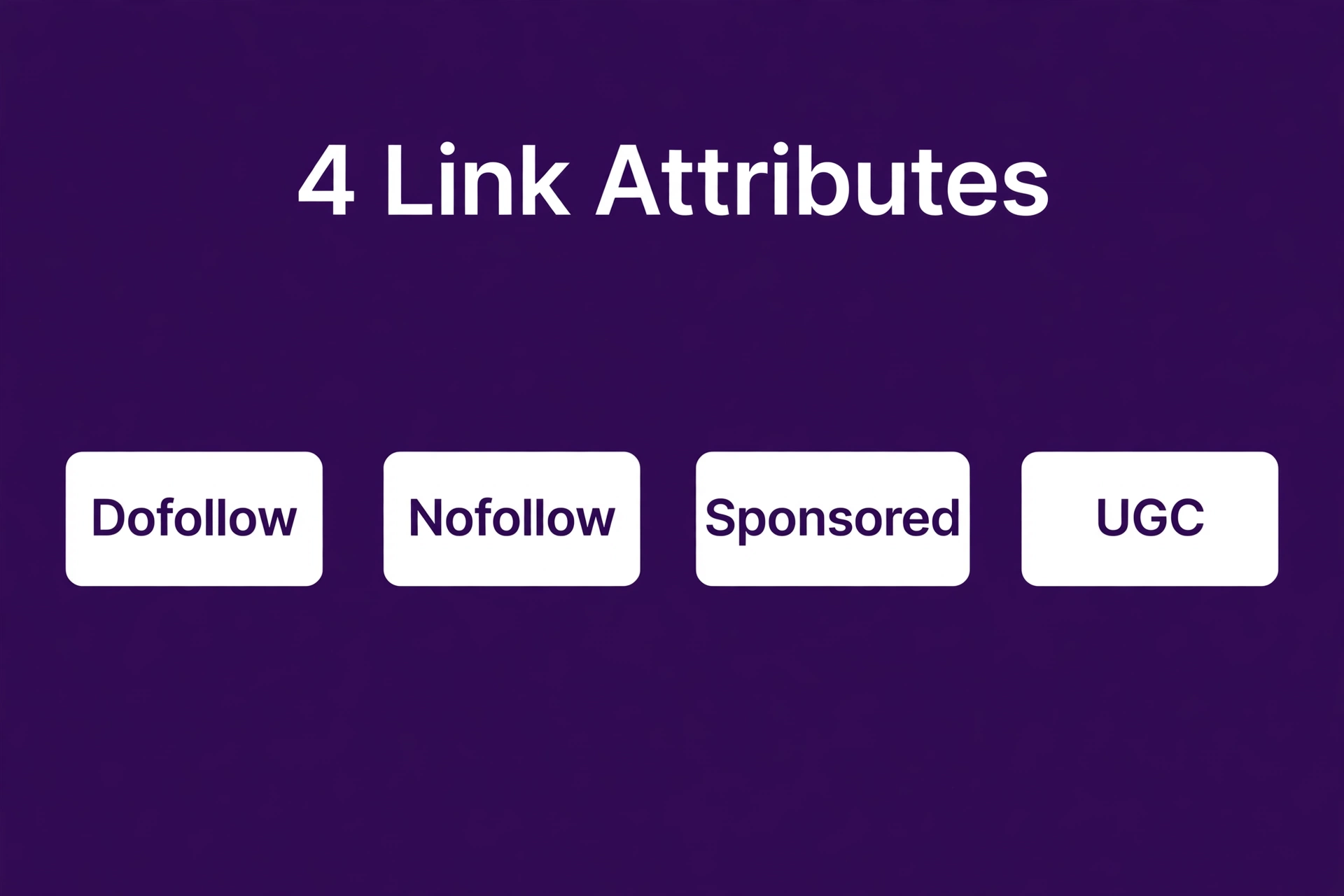
| Type | What it means | Value |
|---|---|---|
| Dofollow | A normal link with no special attribute. It can pass authority. | Highest, when earned editorially |
| Nofollow | Marked rel=”nofollow”. It tells Google not to pass authority. | Still useful for traffic and discovery |
| Sponsored | Marked rel=”sponsored”. Used for paid placements and ads. | Honest disclosure, no authority passed |
| UGC | Marked rel=”ugc”. Used for user generated content like comments and forum posts. | Low authority, natural in small numbers |
One important update: since 2019, Google treats nofollow as a hint, not a strict order. That means a nofollow link is not completely ignored anymore. And nofollow links are not worthless. A nofollow link from a page real people read can still send traffic, get your page discovered, and build your brand. What matters is the mix. A natural profile has both.
Did you know? In September 2019, Google announced that nofollow, sponsored, and UGC would be treated as hints for ranking. Source: Google Search Central Blog.
By how they were earned
Editorial links. A writer or journalist links to your page because it genuinely helps their article. These are the hardest to earn and the most valuable. You cannot buy editorial judgment.
Guest posts. You write an article for another site in your niche, and it includes a link back to your site. Done well, this is legitimate outreach. The article must be original, useful, and on a relevant site. (See our guest posting services.)
Niche edits (link insertions). Your link is added to an existing article that already ranks and already has traffic. This works when the article genuinely needs the resource you offer. (See our link insertions.)
Resource page links. Some sites keep lists of helpful resources on a topic. If your page is genuinely one of the best resources, it can earn a place there.
Directory and citation links. Listings on real business directories and local citation sites. These are foundational rather than powerful, and they matter most for local businesses. (See our local citation services.)
Digital PR links. Coverage earned through newsworthy stories, studies, or data that journalists pick up. These often come from high authority news sites. (See our digital PR.)
Good backlinks vs bad backlinks
| Good backlinks | Bad backlinks |
|---|---|
| From a real site in your niche | From a site built only to sell links |
| Placed inside genuine article content | Hidden in footers, sidebars, or widgets |
| Natural anchor text mix | Same keyword anchor repeated everywhere |
| From pages with real traffic | From pages nobody visits |
| Earned through outreach or great content | Bought in bulk packages of hundreds |
| From many different websites | From one network of connected sites |
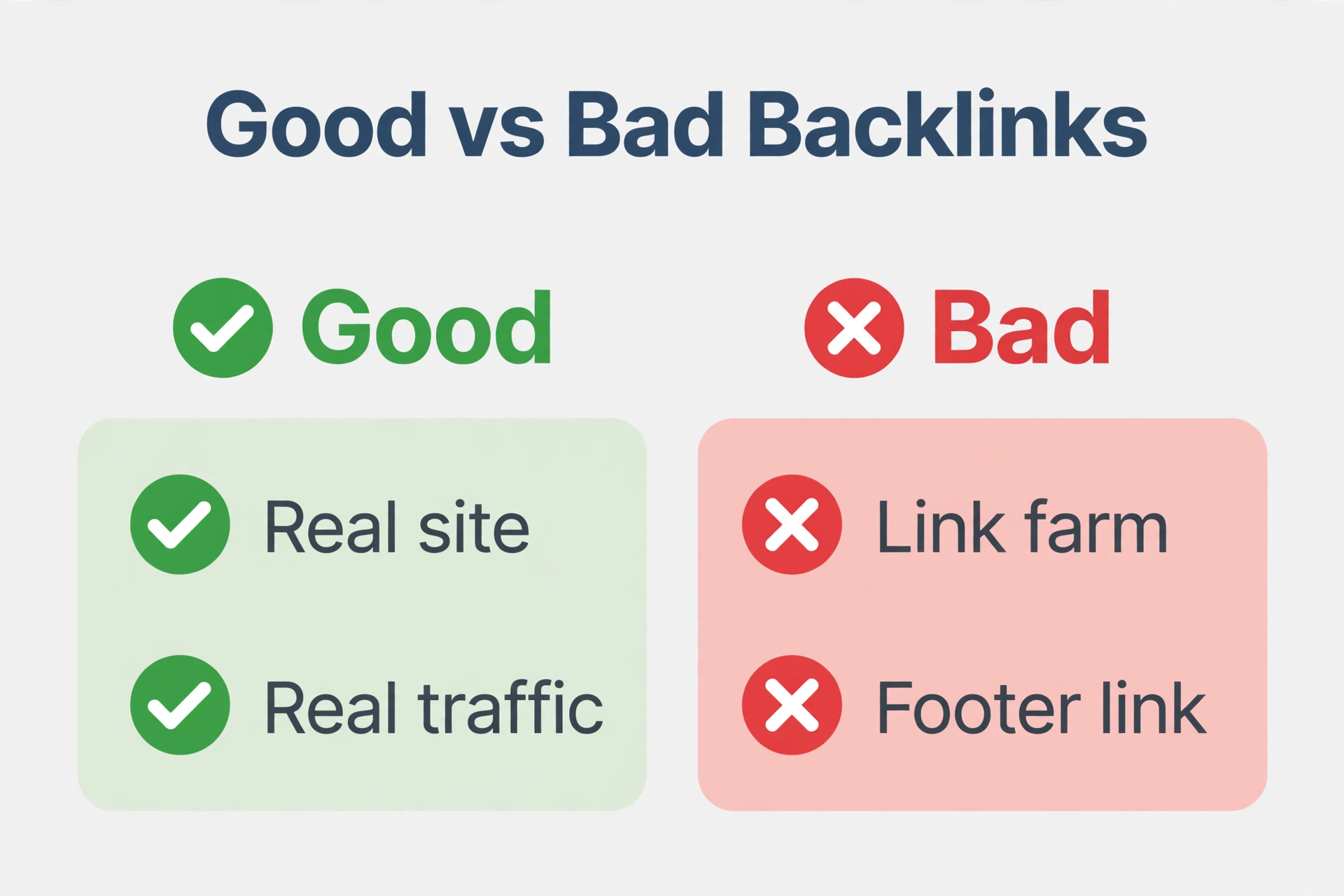
Bad links come in a few familiar forms. Private blog networks (PBNs) are groups of sites built only to sell links. Link farms are pages stuffed with outbound links to anyone who pays. Paid schemes promise hundreds of links in days. All three leave footprints Google has spent years learning to spot.
What happens if you have bad links? Most of the time, Google simply ignores them. They do not help, but they do not hurt either. In rarer, more serious cases, a manual action can push your rankings down until the problem is fixed. That is the penalty people worry about, and it is real, but it usually follows sustained, obvious manipulation, not a handful of weak links.
If you find genuinely harmful links pointing to your site, the last resort is Google’s disavow tool. It tells Google to ignore specific links. Use it carefully and only after an audit, because disavowing good links by mistake can hurt you. Most sites never need it.
How many backlinks do you need?
There is no fixed number, and anyone who gives you one is guessing. The honest answer is: more than your competitors have, on pages that cover your topic, from sites your competitors do not have.
Here is the practical method. Take the top five pages ranking for your target keyword. Check how many unique referring domains each one has. That range is your real target. If the top pages have 30 to 80 referring domains each, then 10 will not move you, and 500 is overkill you probably do not need.
This is also why buying a fixed package of “100 backlinks” makes little sense. The number that matters is the gap between you and the pages already ranking, not a round number in a sales pitch.
How to earn backlinks
Earning links is slower than buying them, and that is exactly why they work. The methods that consistently produce links are:
- Create something worth linking to. Original data, a genuinely useful guide, a free tool, or a clear visual explanation. People link to pages that make their own article better.
- Outreach to relevant sites. Find sites that already write about your topic, and pitch them a specific reason to link: a broken link you can replace, a missing resource, or a fresh angle their readers would value.
- Broken link building. Find dead links on relevant pages, then offer your working page as a replacement. The site owner gets a fix, you get a link.
- Digital PR. Publish something newsworthy, a study, a survey, or a strong opinion with evidence, and pitch it to journalists.
- Reclaim unlinked mentions. If a site already mentions your brand without linking, a polite email often turns that mention into a link.
We cover each of these methods step by step in our upcoming guide on how to get backlinks. If you would rather have someone else do the outreach, our guest posts, niche edits, and digital PR services cover exactly that work, and our buy backlinks page explains how the process runs from brief to live report.
How to check your backlinks
You cannot improve what you cannot see. Start free, in Google Search Console. Open the Links report and you will see your top linked pages, your top linking sites, and your top anchor texts. That alone tells you most of what you need to know at the start.
For deeper data, tools like Ahrefs, Semrush, and Moz show referring domains, authority scores, new and lost links, and your competitors’ profiles. The tool matters less than the habit. Check monthly, watch for sudden spikes of strange links, and track whether your referring domains are growing from real sites.
FAQs
What is a backlink in simple words?
A link from another website to yours. Search engines treat it as a vote of confidence for your page.
What is the difference between a backlink and an internal link?
A backlink comes from another website. An internal link connects two pages on your own website. Only the first is a backlink.
What is the difference between dofollow and nofollow links?
A dofollow link can pass authority. A nofollow link is marked so it does not pass authority directly, but it can still send traffic and help discovery. Since 2019, Google treats nofollow as a hint rather than a strict rule.
Are nofollow backlinks worth anything?
Yes. They bring referral traffic, help Google discover your pages, and make your link profile look natural. A profile with only dofollow links looks engineered.
Can backlinks hurt your website?
Usually Google just ignores bad links. But sustained manipulation, like PBNs and bulk paid schemes, can lead to a manual action that pushes rankings down. Avoid those schemes entirely.
Do backlinks still matter for AI search?
Yes, in a new way. AI Overviews and chat based search cite pages they trust. Strong backlinks and brand mentions are among the clearest trust signals those systems can read. Pages nobody links to or mentions rarely get cited.
How many backlinks do I need to rank?
There is no fixed number. Compare the referring domains of the top five pages for your keyword. Your target is to close the gap with them, not to hit a round number.
How long do backlinks take to affect rankings?
There is no guaranteed timeline. New links first need to be crawled and evaluated, and rankings usually move over weeks rather than days. Anyone promising instant jumps is selling a story, not a service.

About the author
Muhammad Jawad runs Outreach Legends, a link building agency built on one rule: real outreach, real sites, real links. We help agencies, SEO teams, SaaS brands, and e-commerce businesses earn rankings with editorial backlinks from real websites.
Learn more on our Who We Are page or contact us to discuss your campaign.